
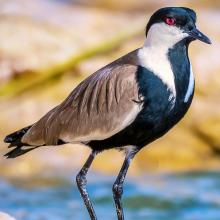
The Spur-winged Lapwing has a distinctive black crown and chest band, long legs, and adults have bright red eyes. One of its most unusual features is the sharp bony spur on each wing, which gives the species its name and is used for defense against predators and other lapwings. Their long legs help them wade in shallow water as they search for food.
Their diet consists mainly of bugs, and occasionally plant material. They search for food on the ground or in shallow wetlands. They are most active at dawn and dusk, and they hunt by sight rather than probing with their beaks he way some other shorebirds do.
Spur-winged Lapwings are highly territorial and vocal, especially during the breeding season. They have loud alarm calls and fearlessly defend their nests and chicks. When threatened, they may dive-bomb predators or humans, sometimes striking with their wing spurs.
Nesting usually occurs on the ground, often in an open scrape with little or no cover. The female lays two to four eggs, which are camouflaged to blend into the surroundings. Both parents share incubation duties and actively guard the nest. Chicks are precocial, meaning they can leave the nest shortly after hatching and follow their parents while learning to forage.
Lapwings thrive in a wide variety of habitats, including natural wetlands, riverbanks, grasslands, farmland, golf courses, and urban parks. Their ability to adapt to human-modified landscapes has helped them expand parts of their range.
The Spur-winged Lapwing is currently listed as Least Concern by the IUCN. Its population is generally stable, and in some areas it is increasing due to its adaptability. However, ground nesting makes it vulnerable to disturbance and habitat loss. Despite these risks, the species remains widespread and resilient.